Custom vs semi-custom vs stock cabinets
Three ways to buy cabinets, what you get with each, and when paying for custom work is genuinely worth it.
By Toronto Millworks, updated October 2026
Three ways to buy cabinets
Stock, semi-custom and custom cabinets are not grades of quality so much as different ways of fitting cabinetry to a room. Stock cabinets ask the room to fit the boxes. Custom cabinets make the boxes fit the room. Semi-custom sits in between.

Stock cabinets
Stock cabinets are built in advance in standard widths, heights and depths, with a limited choice of door styles and finishes. Gaps between the boxes and the walls are closed with filler strips. They are the fastest and least expensive option, and for a rental, a laundry room or a tight budget they can be the right one.
Semi-custom cabinets
Semi-custom cabinets start from a manufacturer's catalogue but allow modifications: different widths and depths, more finishes and more interior options. They are built to order, so lead times are longer than stock. The boxes still come in set increments, so fillers and panels still do some of the fitting.
Custom cabinets
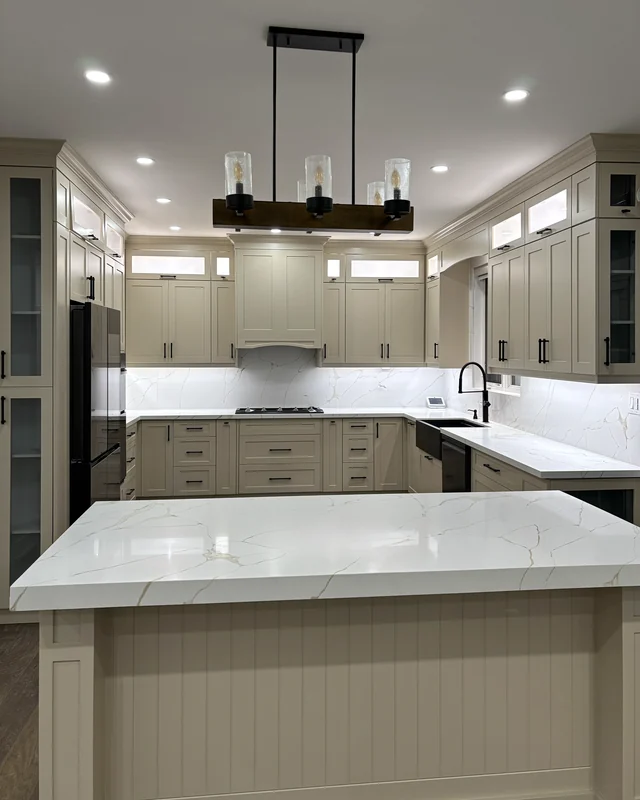
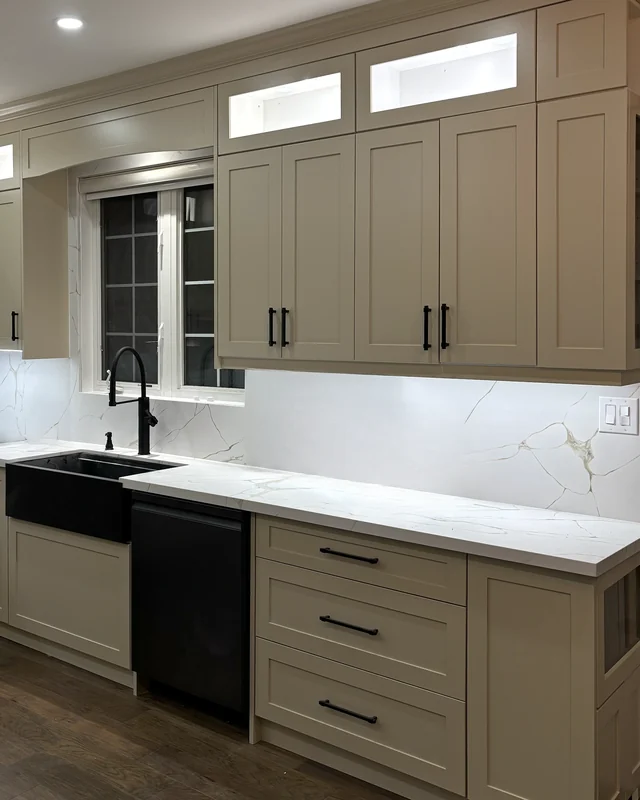
Custom cabinets are designed and built for one room. Any dimension, any material and any detail is possible, the cabinetry can be scribed to walls that are not straight, and it can match millwork already in the house. It takes the longest and usually costs the most, because nothing is drawn from a standard.

Side by side
| Stock | Semi-custom | Custom | |
|---|---|---|---|
| Sizes | Fixed increments | Catalogue, modified | Any dimension |
| Fit at walls | Filler strips | Fillers and panels | Scribed to the wall |
| Materials | Limited | Wider range | Anything suitable |
| Finishes | A few | Many | Any, including matches |
| Lead time | Shortest | Weeks | Longest |
| Relative cost | Lowest | Middle | Highest |
When stock or semi-custom makes sense
- A rental or a house you expect to sell soon.
- A standard room with straight walls and common dimensions.
- A utility space where finish matters less than function.
- A schedule that cannot wait for custom fabrication.
When custom earns its cost
- Older houses where walls, floors and ceilings are out of true.
- Rooms with unusual dimensions, high ceilings or awkward corners.
- Kitchens that need to match existing trim or cabinetry.
- Designs that integrate appliances, lighting and storage closely.
- Homes you plan to stay in, where fit and durability pay back over years.
Quick
answers
Straight answers on cost, lead time and how a job actually runs. If something is not covered here, ask and we will answer it the same way.
Every question we get askedAre custom cabinets better quality than semi-custom?
Not automatically. Quality depends on materials and construction. Custom work's real advantage is fit and flexibility.
Are custom cabinets worth it in an older house?
Usually. Older rooms are rarely square, and custom cabinetry can be scribed to the walls instead of relying on filler strips.
Can custom and stock cabinets be mixed?
Yes. A custom kitchen with stock cabinets in a laundry room is a sensible way to spend where it shows.
Where this applies
More guides
How custom millwork is made
What happens between the first site visit and the day the joinery is finished in your room, and why the order matters.
What affects the cost of custom cabinetry
Why two kitchens of the same length can be priced very differently, and how to spend where it shows.
Paint-grade vs stain-grade millwork
Two ways of building the same piece, chosen by the finish it will wear. Here is what changes and how to choose.
Tell us about the room.
Send drawings, a photo or just the dimensions. We come back with a measured quote, not a per foot guess.
What affects the costWhat are you planning?
Get a quoteNo obligation to go ahead. Measured in your room. Built in our own shop.